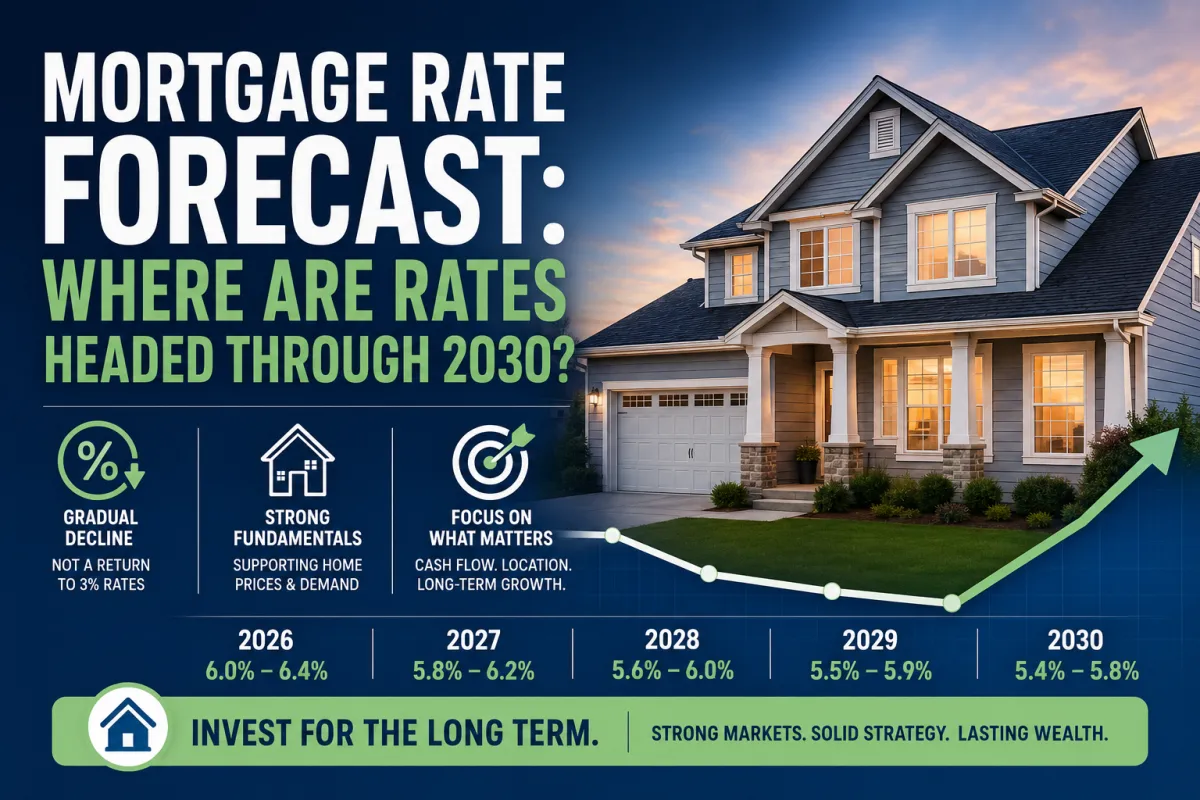
Mortgage Rate Forecast: Where Are Rates Headed Through 2030?
For the past few years, mortgage rates have dominated nearly every real estate conversation—and for good reason. After reaching historic lows during the pandemic, borrowing costs climbed rapidly as the Federal Reserve worked to combat inflation.
While many buyers are still hoping for a return to 3% mortgage rates, most economists agree that those days are likely behind us.
The better question is:
Where are mortgage rates likely to go from here?
Let's take a look at what experts are forecasting through 2030 and what those projections could mean for investors and homebuyers.
Where Mortgage Rates Stand Today
Mortgage rates have stabilized compared to the volatility of the past few years, with the average 30-year fixed mortgage generally remaining in the mid-6% range.
Although rates remain higher than the historic lows of 2020 and 2021, they've become much more predictable as inflation continues to cool and financial markets adjust to a more normal interest rate environment.
Most industry analysts expect mortgage rates to gradually ease over the next several years—but not dramatically.
Mortgage Rate Forecast (2026–2030)
While every forecast is subject to economic conditions, many housing economists expect a slow decline rather than a sharp drop.
The important takeaway?
Most forecasts suggest mortgage rates may settle somewhere around 5.5%–6.0%, not return to the ultra-low rates that existed during the pandemic.
Why Rates Are Staying Higher
Several long-term economic factors continue to influence mortgage rates.
Inflation
Inflation has cooled significantly from its peak, but it remains one of the biggest drivers of interest rates. Until inflation consistently stays near the Federal Reserve's long-term target, mortgage rates are unlikely to fall quickly.
Federal Reserve Policy
While the Federal Reserve doesn't directly control mortgage rates, its decisions heavily influence borrowing costs throughout the economy.
As inflation continues improving, additional rate cuts may become possible, helping mortgage rates gradually trend lower over time.
Treasury Yields
Mortgage rates closely follow the 10-Year U.S. Treasury yield.
When Treasury yields rise, mortgage rates typically rise as well.
When yields fall, mortgage rates often follow.
Housing Supply
Another major factor is the ongoing shortage of available homes.
Millions of homeowners currently have mortgage rates below 4%.
Many are choosing not to sell because replacing that mortgage with today's higher rates would significantly increase their monthly payment.
This "lock-in effect" continues to limit inventory, supporting home prices across many markets.
A Look Back at Mortgage Rate History
Mortgage rates have always moved in cycles.
Over the past two decades we've seen:
History reminds us that today's rates aren't unusually high—they're much closer to long-term historical averages than many people realize.
The exceptionally low rates during 2020 and 2021 were the exception, not the norm.
Three Possible Scenarios
Base Case
The most widely expected outcome.
Mortgage rates gradually ease into the mid-5% range by the end of the decade as inflation continues to normalize and the economy remains relatively stable.
Optimistic Scenario
If inflation falls faster than expected and economic growth slows modestly without a recession, mortgage rates could move closer to 5%.
While possible, most economists view this as the less likely outcome.
Conservative Scenario
If inflation remains stubborn or new economic shocks emerge, mortgage rates could remain above 6% for several more years.
Even under this scenario, most analysts do not expect a return to the extreme rate spikes seen during recent inflationary periods.
What This Means for Real Estate Investors
Many investors make the mistake of waiting for "perfect" mortgage rates.
History suggests that strategy often backfires.
Real estate values, rental demand, and long-term appreciation have historically been driven by much more than interest rates alone.
Successful investors typically focus on:
Buying quality assets in growing markets.
Strong monthly cash flow.
Long-term appreciation potential.
Conservative financing.
Reliable property management.
Those fundamentals tend to matter far more over a 10- or 20-year investment horizon than trying to perfectly time mortgage rates.
Why Turnkey Markets Continue to Stand Out
Even in today's interest rate environment, many secondary markets continue to offer attractive investment opportunities.
Markets like Fayetteville, North Carolina, continue to benefit from:
Strong rental demand
Military-driven employment stability
Affordable entry prices
Consistent population growth
Attractive cash flow opportunities compared to many higher-priced coastal markets
For investors focused on building long-term wealth, these fundamentals often outweigh short-term interest rate fluctuations.
Final Thoughts
Mortgage rates are expected to gradually move lower over the next several years, but a return to the record-low rates of 2020 and 2021 remains unlikely.
Rather than waiting for the "perfect" rate, many experienced investors focus on buying quality properties in markets with strong long-term fundamentals. If rates decline in the future, refinancing is always an option—but opportunities to purchase well-located investment properties may become more competitive as borrowing costs fall.
The key is to invest based on fundamentals, not headlines.
Explore Turnkey Investment Opportunities
Visit www.turnkeyproppro.com
Browse our available turnkey rental properties, explore current market insights, and connect with our team to learn how investing in stable, cash-flow-focused markets like Fayetteville, North Carolina can help you build long-term wealth regardless of where mortgage rates go next.
